Patrick Lencioni’s teamwork model

The Five Dysfunctions of a Team – from the book to your team

Patrick Lencioni’s book The Five Dysfunctions of a Team gives teams a clear framework for how they work together. The Five Behaviors®, developed by Wiley in partnership with Lencioni, applies that framework through personalised insight and development.

On this site you can buy the official Five Behaviours Team Development and Personal Development profiles, and book facilitated workshops with Mission Group.

A team discussing a problem together in a workshop setting

Why the book resonates

Most people have worked in a team where everyone was capable, yet the team still struggled. Meetings were polite but guarded, real disagreements happened in the corridor afterwards, decisions were revisited, and people protected their own objectives rather than the team’s.

Lencioni’s book, told as a short workplace story, gives names to those patterns and shows how they connect. With millions of copies sold, it’s a model many people already recognise – which makes it easier to start a conversation about how your own team works. Recognising the model is a starting point, though, not a diagnosis of any particular team.

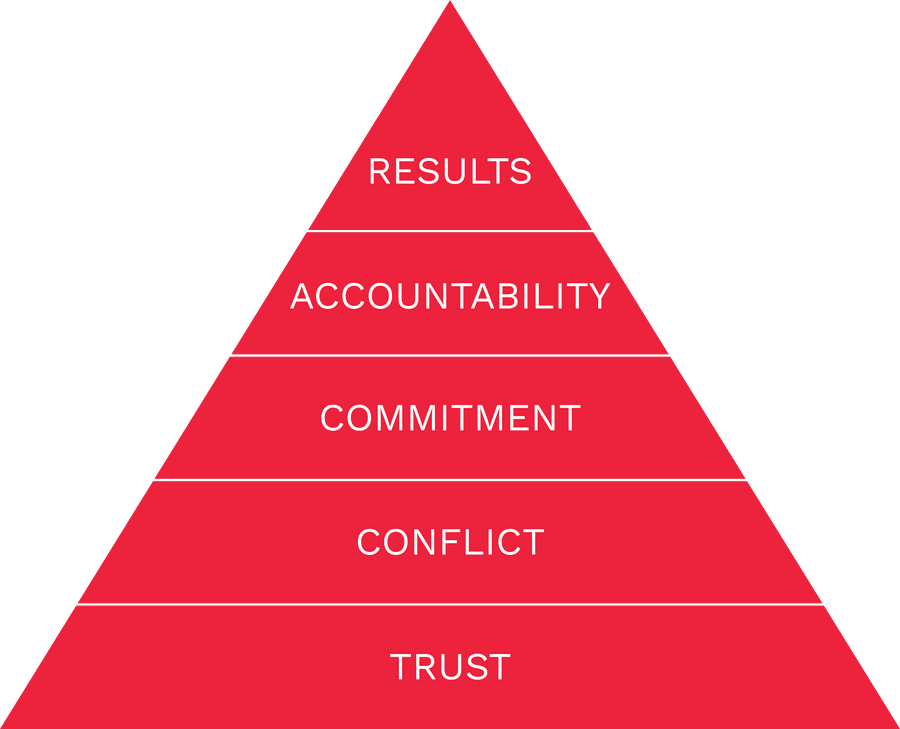
The five dysfunctions and the behaviours that replace them

The model is usually drawn as a pyramid. Trust is the foundation: without it, people avoid open conflict about ideas; without that debate, commitment to decisions is weak; without commitment, people hesitate to hold one another accountable; and without accountability, attention drifts from the team’s collective results. The Five Behaviors of a Cohesive Team model, which Wiley built on that framework, turns each dysfunction into a positive behaviour the team can work on.

  1. Building trust

    Level 1 of 5 – the foundationreplaces the absence of trust

    People are open about mistakes, weaknesses and concerns with one another, and ask for help when they need it.

  2. Mastering conflict

    Level 2 of 5replaces the fear of conflict

    The team engages in productive, candid debate about ideas rather than keeping an artificial peace.

  3. Achieving commitment

    Level 3 of 5replaces a lack of commitment

    Decisions are clear and people commit to them, even when they argued for something else.

  4. Embracing accountability

    Level 4 of 5replaces the avoidance of accountability

    Team members hold one another to agreed decisions and standards, not just the leader.

  5. Focusing on results

    Level 5 of 5 – the apexreplaces inattention to results

    Collective outcomes come ahead of individual status, targets or agendas.

The Five Behaviors® model drawn as a pyramid. The five levels are listed below it from the base upwards: Trust at the foundation, then Conflict, Commitment and Accountability, with collective Results at the apex. Each level rests on the one below it.

Dysfunction names follow Lencioni’s book; behaviour names follow the Five Behaviours reports published by Wiley.

From understanding to application

Reading about the five dysfunctions is one thing; talking honestly about how they show up in your own team is harder. Wiley developed The Five Behaviours in partnership with Patrick Lencioni to help with that step, combining his model with personalised insight from an online assessment. Lencioni also appears in videos used throughout The Five Behaviours facilitated learning sessions.

Wiley focuses on behaviours rather than dysfunctions for a practical reason: when a team is discussing itself rather than an abstract team, concrete, positive actions and goals are more useful than a list of faults. In practice, the profiles help in three ways:

  • Personal reflection – each participant receives a personalised report showing their own tendencies across the five behaviours.
  • A shared picture – with Team Development, the team’s results are brought together so it can see where it is strong and where it gets stuck. Team Development also shows each person’s DiSC® style and the styles of others in the team.
  • Practical conversations – the reports give the team a common language and specific points to discuss, so the conversation leads to agreed actions rather than general impressions.

Assessment choices based on the model

Several tools use Lencioni’s model as their starting point. They are made by different organisations and do different jobs, so it helps to know what each one gives you.

Book-based reflection tools, The Five Behaviors Team Development and Personal Development, and The Table Group’s Five Dysfunctions Team Assessment compared
  Book and introductory reflection tools The Five Behaviors® Team Development
Published by Wiley
The Five Behaviors® Personal Development
Published by Wiley
The Table Group’s Five Dysfunctions Team Assessment
What it is The book itself, plus checklists and discussion questions drawn from it Online assessment for each team member, with personalised reports and team-level results Online assessment for an individual, with a personalised report A 42-question online team assessment with a colour-coded team report
Best for A quick introduction or conversation-starter An intact team that works together Individuals, or cohorts whose members don’t all work in one team A team that wants a focused measure of its performance across the five dysfunctions
Personalised individual report No – usually self-scored Yes, for each participant Yes No – the report is about the team
Team-level results Only as far as the team combines and discusses its answers Yes – built from every participant’s responses No combined team diagnosis Yes – team scores for each area and where views differ
DiSC® No Yes – shows each person’s DiSC style and the styles of others in the team DiSC-based personalisation, without naming a DiSC style No
Price Free, or the cost of the book £135 + VAT (£162.00 inc VAT) per person, minimum order 3 £99 + VAT (£118.80 inc VAT) per person Set by The Table Group – see their website
Where to get it Booksellers and free online resources Buy here – Team Development Buy here – Personal Development The Table Group’s website

Details of The Table Group’s assessment are taken from its website, checked in September 2026. We don’t sell or administer it.

There isn’t a single right answer. The Table Group’s assessment is a focused, team-level measure from Lencioni’s own company. The Five Behaviors profiles add a personalised report for every participant, which suits teams that want each person to reflect on their own part as well as the team’s. A free questionnaire can be a sensible first step for either.

Which route fits your situation?

The right choice depends on who is taking part and how you want to use the results.

You want to work on one intact team

A leadership team, management team or any team with shared goals and responsibility for results wants to build greater trust, alignment and collective effectiveness.

Recommended: Team Development

Each person gets a personalised report and the team gets a shared picture to discuss.

See Team Development

You’re developing a mixed group

The participants come from different teams, or you’re running a programme for individuals.

Recommended: Personal Development

It builds each person’s teamwork skills without assuming everyone belongs to one team.

See Personal Development

You want help applying it

You’d like an experienced facilitator to run the conversation so the leader can take part fully.

Recommended: A facilitated workshop

Mission Group facilitators help the team work through its results and agree actions.

See facilitated workshops

You’re planning across an organisation

You’re arranging profiles for several teams, or combining teams and cohorts.

Recommended: Our guide for organisations

It explains how to choose, group and order profiles for more than one team.

Choose profiles for your organisation

Want the exact differences between the two Five Behaviours profiles? See the detailed Team vs Personal Development comparison.

Read the book and want to put it into practice with your team?

Mission Group runs facilitated workshops using The Five Behaviors®. Your team completes the assessment first; the session then brings the model to life with the team’s own results, practical exercises and open discussion, and ends with actions the team has agreed and owns.

A facilitator can raise difficult issues, keep challenge constructive and let the team leader take part as a member of the team rather than running the meeting. Sessions can be virtual or in person.

Explore Five Behaviours workshops

Questions about the book and the assessments

How is The Five Behaviours connected to The Five Dysfunctions of a Team?

The Five Behaviours was developed by Wiley in partnership with Patrick Lencioni and is based on the model in his book The Five Dysfunctions of a Team. It uses the same five areas, framed positively as Trust, Conflict, Commitment, Accountability and Results, and combines them with personalised insight from an online assessment. Lencioni also features in videos used in The Five Behaviours facilitated learning sessions.

How is it different from The Table Group’s Five Dysfunctions Team Assessment?

They are separate products from separate organisations, both connected to Lencioni’s work. The Table Group, Lencioni’s own company, offers a 42-question online team assessment with a colour-coded report on the team’s performance across the five dysfunctions. The Five Behaviors profiles, published by Wiley, give each participant a personalised report, and Team Development adds a team-level view and each person’s DiSC® style. We sell The Five Behaviors profiles; for The Table Group’s assessment, see The Table Group’s website.

Do we need to have read the book first?

No, reading the book isn’t required. The reports explain the model in their own right, so participants can take the assessment without having read it. The book is useful background, though, and some teams like to read it alongside their results.

Which profile should we choose?

If everyone works together as one intact team, choose Team Development (£135 + VAT (£162.00 inc VAT) per person, minimum 3 profiles). If you’re buying for individuals, or a group whose members don’t all work in one team, choose Personal Development (£99 + VAT (£118.80 inc VAT) per person). The Team vs Personal Development comparison walks through the decision.

Can we buy the profiles without Mission Group facilitation?

Yes. You can buy the profiles on their own and run the conversation yourself or with an internal facilitator. We send assessment invitations and monitor completion. Facilitated workshops are optional and priced separately.

Is there a free Five Dysfunctions questionnaire?

Free checklists and discussion questionnaires based on the book are widely available and can be a useful conversation-starter. They are usually self-scored by the team and don’t produce a personalised report for each participant, which is the main difference from a paid assessment.

Ready to take the next step?

Compare the two profiles, see what participants receive, or talk to us about a workshop.

Ready to buy? Go straight to Team Development or Personal Development, or browse all sample reports.